Explore before you arrive: an interactive 3D guesthouse experiment
Walk around a concept guesthouse, collect an exploration guide, try a swing and look inside a room. Our experiment adds active exploration to an online spatial presentation.
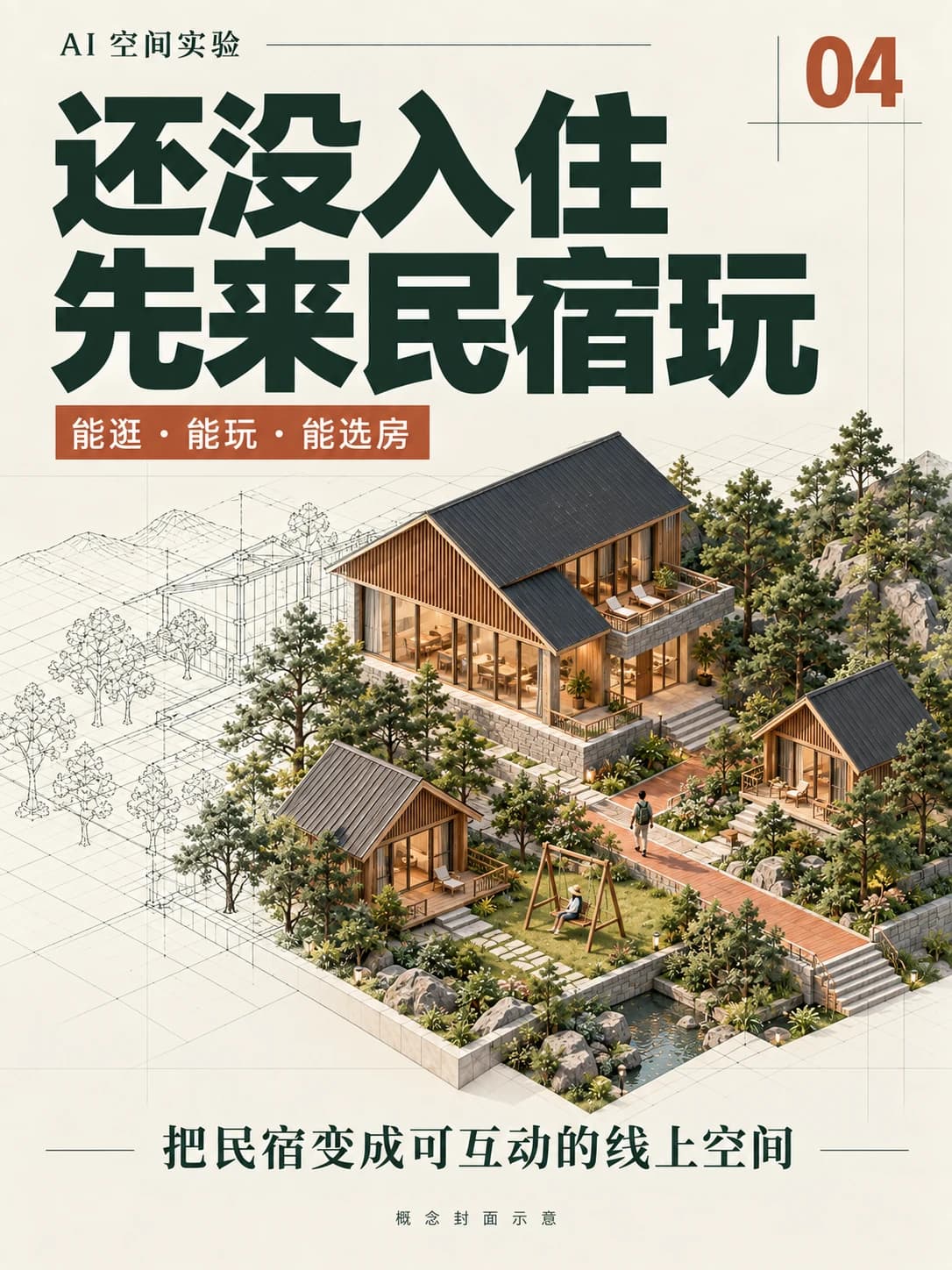
Make viewing a guesthouse an active experience
What if guests could explore before traveling? We used AI in creating a 3D concept guesthouse where viewers can walk, rotate the view and enter a room. The question is whether a space can help people form a more concrete impression.
This article is based on the episode’s published copy and completion record dated September 21, 2026. The demonstrated interactions were recorded from the running concept application; the cover is an illustration. The experiment does not establish booking conversion or revenue gains.
See the grounds, then choose where to go
The recording starts with a character walking outside, then rotates around the grounds. An overview explains the relationship between buildings and shared spaces; walking brings attention to a specific route.
Our design judgment is that these views can complement each other: understanding what is where helps a visitor decide where to go. That judgment has not been quantified through user research.
Give visitors a reason to pause
The completed record includes collecting and viewing an exploration guide, entering the swing, and seeing the character swing with the controls visible. The guide offers a starting point, while the swing makes an object participatory.
The recording does not show completing the swing challenge, so we do not claim a full completion flow. The smaller experience matters: approach something, understand an available action, try it and see feedback.
Enter a room and examine the view
The demo selects room R12, opens an interior preview and shows movement and looking around. Viewers can choose a position and inspect the layout and view rather than relying on a fixed render.
This is a concept room, not a surveyed reconstruction of an actual property. Real room dimensions, views, equipment and access would still need to be checked against the property.
Express preferences for a group stay
The completed footage also shows accommodation suggestions for two families—four adults and two children—and a location-preference submission. This organizes preferences for further discussion; the hotel would still confirm the room assignment.
Inventory is demonstration data. The record does not prove a live PMS connection, room locking, order creation or payment. Submitting a preference and completing a booking are different service stages and should be presented clearly.
A sequence we can learn from
The completed experience can be described as overview → find an entry point → try an interaction → enter a room → express a preference. This is a design interpretation of the result, not a reconstruction of every development operation or its strict chronology.
- Explain spatial relationships before offering exploration choices.
- Complete one understandable interaction before expanding the range.
- Check layout and views without presenting concept art as real property evidence.
- Make the outcome of a preference submission explicit.
What would you let a guest try first?
The demo supports discussion of online presentation, visitor routes and interaction choices. Its narrow-screen recording was captured in a desktop browser, not on a physical phone. We have no business-performance measurements.
Would you start with free exploration, a small game or a room view? Specify a place, an action and what you want the guest to understand: for example, walking onto a terrace to see the sunset direction. An interaction connected to the place is worth testing before adding many unrelated activities.
Key Takeaways
- Interactions should help visitors understand the place and accommodation choices.
- The recorded demo includes a guide, swing, room exploration and family location preferences.
- Inventory is demo data; submitting a preference is not a reservation or payment.
Related Articles
I built a 3D campus with AI. Come take a walk.
Putting buildings, roads and viewpoints in one space makes scale and connections easier to discuss. Our first experiment starts at campus scale.
Read MoreThe Little Prince in 3D: how can a story happen in a space?
Sac’s scenes, character pipeline and watering-can animation suggest a practical starting point: validate one meaningful experience, then expand the world.
Read MoreDesign classroom point rules that students can understand
Connect specific behaviors to consistent points, pet growth and rewards, and use homework completion records to support your rules.
Read More